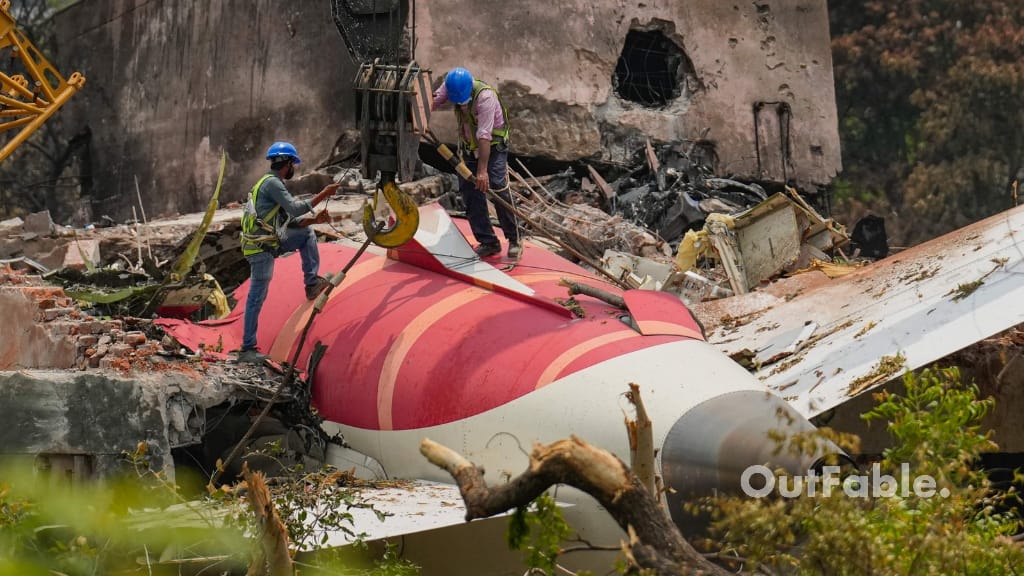
The tragic crash of Air India Flight AI 171 on June 12, 2025, which shocked the whole country with at least 260 deaths, including 19 on the ground, is now making headlines again following the surfacing of a detailed preliminary investigation report by the Aircraft Accident Investigation Bureau (AAIB). The flight, a Boeing 787-8 Dreamliner, crashed shortly after take-off from Ahmedabad, with early findings pointing to an unexpected and catastrophic shutdown of both engines just seconds after liftoff.
As per reports, the flight lasted around 30 seconds between takeoff and crash and the latest development reveals that merely three seconds after becoming airborne at 1:38:39 p.m., both fuel control switches, critical mechanisms that regulate fuel supply to aircraft engines, switched from RUN to CUTOFF, shutting down the engines within a second. The switches transitioned one after another, with just a one-second gap. The shutdown occurred at 1:38:42 p.m., initiating a series of irreversible heart wrenching crash just seconds later, at 1:39:11 p.m., when the black box stopped recording.
The recording of the conversation between both pilots taken from the cockpit voice recorder hints at confusion in the cockpit. One pilot asked, “Why did you cutoff?” to which the other responded, “I did not do so.” The report does not clarify which of the two, Pilot-in-Command Captain Sumeet Sabharwal or First Officer Clive Kundar, made the statement. The transcript of this crucial cockpit exchange has not been released to the public.
Investigation Focus: Mechanical Fault or Human Error?
Aviation experts are now questioning how such a vital safety mechanism could have malfunctioned mid-air. According to pilot protocols, fuel control switches are operated only during engine start-up or shutdown, and are designed with spring-loaded brackets and stop locks to prevent accidental toggling. To move the switch from RUN to CUTOFF, pilots must lift and then rotate it manually, making unknown movement extremely unlikely.
Yet, the aircraft’s flight data recorder shows that both switches returned to RUN, the normal operating position, within 10 to 12 seconds, implying an attempt to recover engine power. One of the engines began to regain thrust, but the second engine failed to pickup and most importantly the low altitude left no margin to get back on track.
Despite the presence of safeguards and backup systems like the Ram Air Turbine (RAT) and Auxiliary Power Unit (APU), the aircraft continued to lose altitude and eventually MAYDAY was called out followed by crash just outside the airport boundary. CCTV footage show the RAT’s deployment immediately after the engines failed, consistent with complete engine shutdown.
FAA Advisory Overlooked, Maintenance Records Clean
Adding to the concerns is an FAA advisory issued in December 2018, which warned of potential disengagement of the fuel switch locking mechanism. While the advisory was based on similar switches in Boeing 737s, the 787’s design shares the same module. Air India, however, did not conduct the recommended inspections, citing the advisory’s non-mandatory status. The aircraft’s throttle control module, housing the switches, was last replaced in 2023, and no defects were reported regarding the fuel switch system.
AAIB investigators confirmed that all relevant airworthiness directives and service bulletins had been complied with, and that no abnormalities were found in the maintenance records. Notably, the last check of this aircraft had occurred shortly before the flight, and both pilots were cleared as fit with no alcohol detected in breathalyser tests.
Sequence of Final Moments
Here’s a reconstruction of the critical final minutes based on the preliminary report:
1:37:37 p.m.: Aircraft begins take-off roll.
1:38:39 p.m.: Aircraft lifts off.
1:38:42 p.m.: Both engines shut down as fuel switches move to CUTOFF.
1:38:47 p.m.: Ram Air Turbine deployed, indicating total power loss.
1:38:52-1:38:54 p.m.: Switches toggled back to RUN.
1:39:05 p.m.: “MAYDAY” call issued from cockpit, but no identification follows.
1:39:11 p.m.: Black box stops recording.
1:44:44 p.m.: Emergency response teams dispatched from airport.
Pilots Under Spotlight
Given that Captain Sumeet Sabharwal had over 8,200 hours of flying experience, was the monitoring pilot, while First Officer Clive Kundar, with 1,100 hours, was the flying pilot, plus both were well-rested and medically fit, and still the event happened makes everything serious.
Experts now suggest that unless further evidence such as a mechanical failure in the switch lock system, emerges, the focus of the investigation may shift to cockpit error or procedural lapse.
What Comes Next?
While the preliminary report does not put blame, it serves as a support for in-depth investigation. Aviation analyst Amit Singh, founder of the NGO Safety Matters, noted that until the exact mechanism of fuel switch transition is explained, the mystery will remain unresolved. He stressed the importance of releasing the full voice recording transcript and further analyzing the cockpit control interface.